
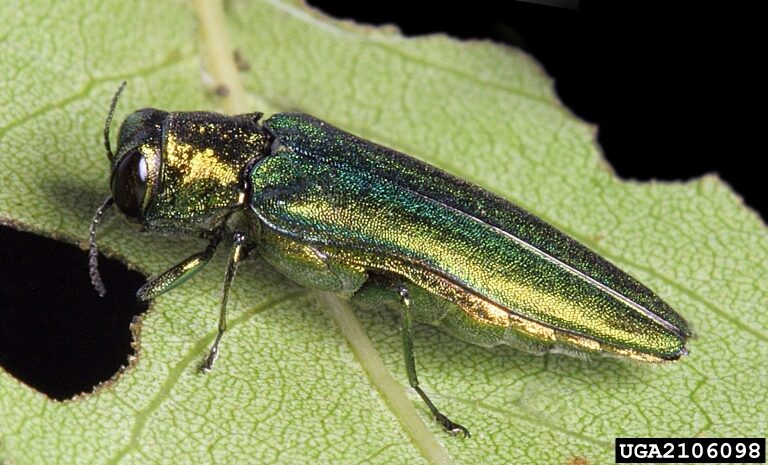
Portland Parks & Recreation’s (PP&R) Urban Forestry division has developed an Emerald Ash Borer (EAB) Response Plan to manage the arrival of this highly destructive tree pest. Though EAB has not yet been confirmed in Portland, infestations have already been found in nearby Clackamas, Marion, Yamhill, and Washington counties. PP&R released a detailed statement that follows and also posted it on their website.
What is the emerald ash borer?
EAB is an invasive beetle that attacks and kills all species of ash trees, including the native Oregon ash (Fraxinus latifolia). Since it was first discovered in Michigan in 2002, it has killed over 100 million trees across the U.S. and is considered North America’s most destructive forest pest.
Portland has an estimated 95,000 ash trees, found in parks, neighborhoods, natural areas, and yards. Once EAB arrives, it will threaten these trees and could lead to major canopy loss —impacting wildlife, stream health, and neighborhood shade.
EAB cannot be eradicated, which is why preventing the arrival of EAB and slowing its spread throughout the city is crucial. With the EAB Response Plan, the City of Portland is working proactively to lessen the impact this pest will have on the community.
City Forester Jenn Cairo said diversifying Portland’s canopy is integral in preparing for invasive pests such as EAB. “This is why we actively push for diverse species when we plant and promote tree planting,” said Cairo. “So that when a disease or pest attacks one species, it causes less harm to the canopy as a whole.”
What the city is doing
The EAB Response Plan outlines how Portland will work to:
- Slow the spread of EAB.
- Protect public safety.
- Preserve ash trees where possible.
- Spread costs and actions over time.
- Proactive measures are already underway: PP&R is treating healthy ash trees in city parks with insecticide to prevent infestation and new permit rules allow residents to treat street trees or remove and replace small ash trees (under 6 inches in diameter) with free permits.
PP&R’s Urban Forestry team continues to work with the Oregon Department of Forestry (ODF), Oregon Department of Agriculture, and community partners on Statewide strategies to help limit their impact.
“I appreciate the City Forester’s science-based approach to managing our urban forest,” said Priya Dhanapal, deputy city administrator for public works. “By diversifying tree species, using data-driven tools, and planning ahead, we’re better prepared to face threats like EAB and build a resilient, healthy canopy.”
PP&R’s Urban Forestry team is further helping by:
- Mapping and keeping inventories of ash (and other) trees across the city to enhance forest management and protection.
- Removing (in 2019) ash tree species from the City of Portland’s Approved Street Tree Planting List.
- Requiring species diversity in regulated tree planting.
- Ensuring species diversity and avoiding ash in tree give aways and planting programs.
- Joining with ODF in creating the State of Oregon’s emerald ash borer response plan.
How you can help
EAB spreads mostly when humans move or transport infested wood, especially firewood. To help protect Portland’s urban forest:
- Buy firewood locally—don’t move it from other areas
- Learn to identify ash trees and signs of EAB
- Report suspected sightings or unhealthy ash trees to the Oregon Invasive Species Hotline
Manage your ash trees
- Talk to a certified arborist about treatment or removal
- Healthy trees can be treated with a permit
- Small ash trees should be removed and replaced with other species
Tree care providers should be familiar with EAB symptoms and how to dispose of ash wood responsibly.
Stay informed
- Visit PP&R Urban Forestry’s emerald ash borer webpage for updates and resources.
- Read ODF’s emerald ash borer factsheet.
- If you have questions, please contact PP&R Urban Forestry at 503-823-8133 or Trees@PortlandOregon.gov.
Everyone has a role to play. With your help, Portland can slow the spread and protect the city’s trees.