
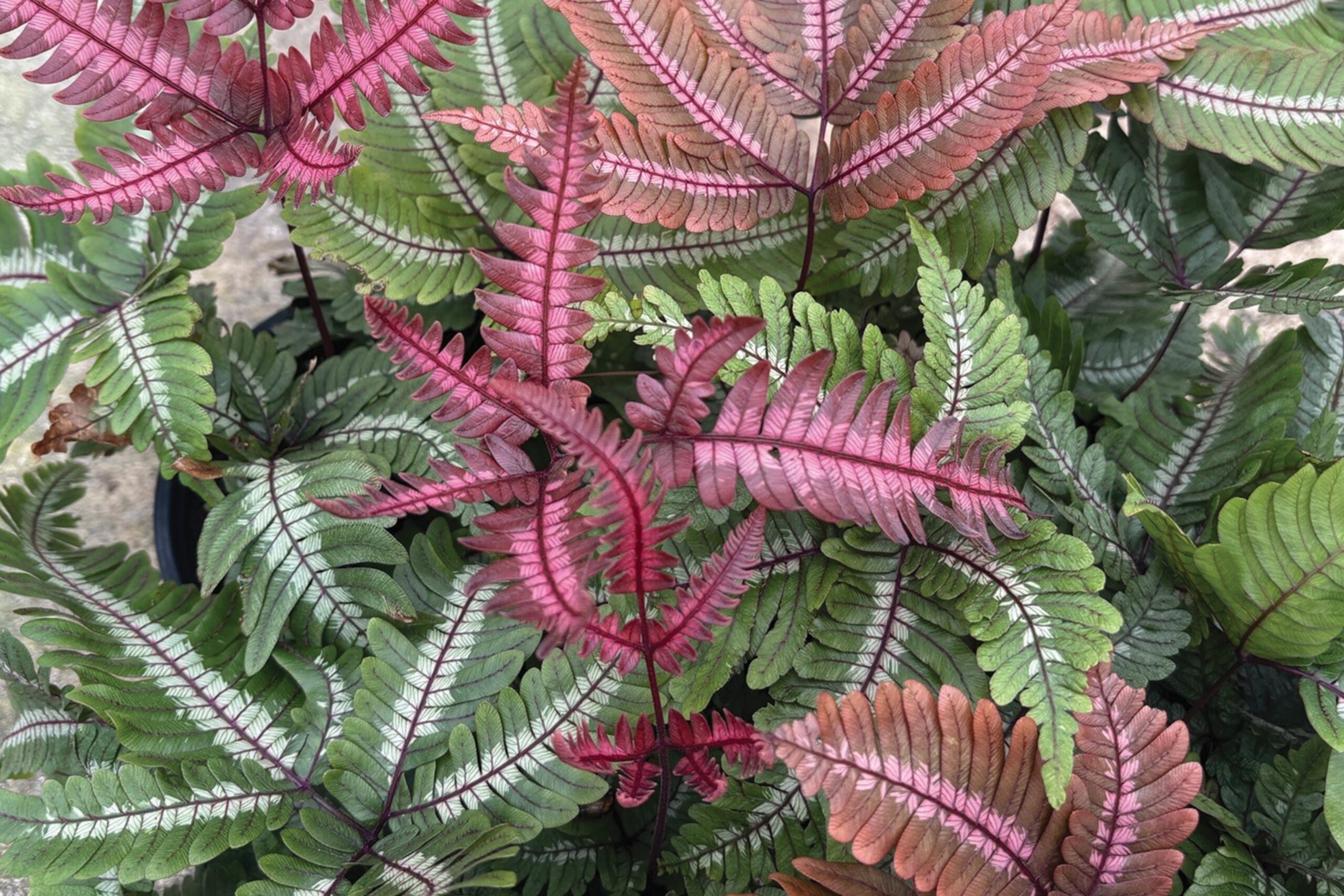
Tropical plants with red leaves or flowers have been popular for a long time, but consumer fascination shows no signs of waning. In fact, the trend has now broadened to include plants with hues of pink and burgundy.
Mackenzie Allaert, office manager and HR director at wholesale grower Youngblood Nursery Inc. in Salem, Oregon, said she’s seen a rise in plants with red, pink and burgundy tones. They are very good holiday plants for Valentine’s Day, Mother’s Day and Christmas. But beyond holidays growers are increasingly producing new varieties with pink and red tones, making them more accessible in the retail market and therefore more popular.
Color sells
Ann Patterson, houseplant buyer at two-location retailer Portland Nursery (Portland, Oregon), said that just like in any retail situation, color sells.
“Pink and red variegated plants can look really marvelous,” Patterson said. “They can pop in a group of plants so I can see why they’re popular.”
“Who doesn’t love a pink plant?,” said Michelle Bundy, the foliage lead at wholesale grower Casa Flora in Dallas, Texas. “As the foliage lead for Casa Flora, I have seen the increase in sales among our pink and purple plants and the constant desire for anything with a pink leaf.”
Variegation
Variegated plants have been popular for a long time, as a theme that is important in the American market, said Andrej Suske, owner of Cascade Tropicals in Snohomish, Washington.
“In general, we see the yellow and white variegation as the most popular and I haven’t really seen that change,” Suske said. “If you can add some red or pink tones to a white or yellow variegation, that is definitely something that is popular, but it’s also a bit more rare to see that.”
He added that plants that have purple or red leaves are not rare at all so they’re not as popular unless they have clear lines of white or pink in the leaves.
“But anything that makes a leaf more interesting is a good thing,” Suske said.
Patterson said she walked through a greenhouse and found 15 examples of tropical plants with red or pink tones without trying. She said there are many other philodendrons that have red variegation, as well as several begonias.
“The Ficus elastica ‘Ruby’ is easy to grow,” Patterson said. “And there’s the trailing inch plant Tradescantia, and a lot of others like Calathea and Hypoestes phyllostachya ‘Polka Dot’,” Patterson said.
Allaert also named a few examples, including the Philodendron ‘Red Heart,’ Aglaonema ‘Siam Aura’, Philodendron ‘Strawberry Shake,’ Begonia ‘Cracklin Rosie,’ and Ludisa discolor ‘Sea Turtle’.
Suske said the Tradescantia albiflora ‘Nanouk’ is one of the best examples of why red and pink is very popular.
“It’s easy to grow and hard to kill, and not very expensive,” Suske said. “It’s a good entry plant for those getting into houseplants and hopefully they will buy others like the Begonia exotica, which is also not as expensive and it’s easy to grow.”
He said one of his favorite colorful succulents is Portulacaria afra ‘Medio-picta’. A new Philodendron being developed in tissue culture is the ‘Pink Bikini’.
Bundy said from Calathea to Aglaonema, more pink varieties continue to be brought to market.
“Collectors online go wild when they have a plant that pops out a rouge pink leaf,” Bundy said.
Looking ahead
Bundy said she sees the trend of tropical plants with red and pink hues continuing, especially as they are becoming more affordable and less exclusive, like with the ‘Pink Princess’.
Allaert said she thinks the trend will always be sought after but might slow down as the next best thing comes out.
Suske said he thinks social media will continue to drive trends too, as it did for the pink and red variegated plants.
“If there are cool pictures that get enough traction, people are going to gravitate to them. And as soon as those are replaced by something else, they will move on to that,” Suske said.
Suske said he thinks variegation will always be popular. “I think what will happen is that now that more breeding is happening in houseplants — because breeders see there’s money there — there’s a big market,” Suske said. “We will likely see more plants that have variegation and maybe more plants that have white and pink variegation on the same leaf.”
He said if a plant breeder developed a new Monstera with pink variegation, it would be very successful because people look for the mix of pink and green on one leaf.
Emily Hoard is an Oregon-based freelance journalist covering business, environmental and agricultural news. She has a background in community reporting and a master’s degree in multimedia journalism. You can reach her at Hoarde123@Gmail.com