
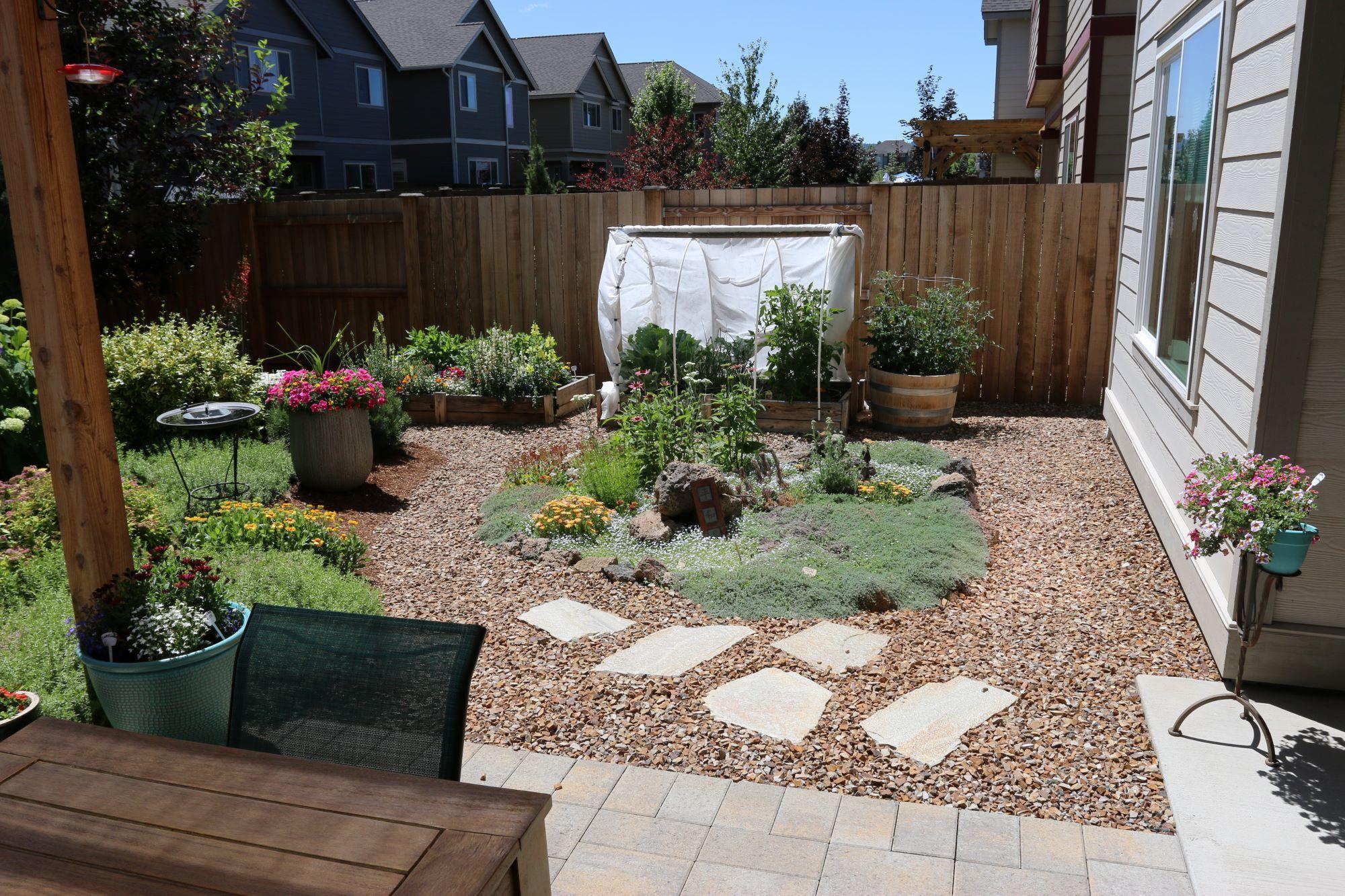
The 2020 heat dome and worsening fire seasons have made one thing clear: wildfire risk is rising in the Pacific Northwest. How can we still have beautiful landscapes without fueling a fire?
That’s where fire-wise landscaping comes in. By choosing the right plants and creating defensible space around homes, gardeners can enjoy their yards with more peace of mind.
Experts can offer strategies to make your landscape both beautiful and safer.
“We’re seeing wildfires in urban communities as well as natural forests — it’s not only occurring in the wildland urban interface,” said Amy Jo Detweiler, an Oregon State University Central Oregon extension horticulturist and professor.
“If a fire starts in an urban environment, plant material can contribute as a fuel source. It’s something everyone needs to be managing.”
Creating defensible zones
Fire-wise landscaping starts by reducing fuel around the home. Experts recommend thinking in three zones:
Zone 1: less than 5 feet from the house (Immediate Zone)
- Keep this area free of all combustibles including plants and mulch.
- Use gravel or hardscaping.
- Prune back any branches overhanging or within ten feet of the roof or siding.
- Use non-combustible building materials.
Zone 2: 5–30 feet (Intermediate Zone)
- Group fire-wise plants in islands, spaced apart with fuel breaks.
- Create fuel breaks with mowed lawn or gravel paths.
- Avoid “ladder fuels” like tall grasses, dense shrubs, or tree limbs near the ground.
If you plant conifers, limb them up, and remove flammable plants or other combustibles around the trunk. “Design and spacing is a critical component of creating those fuel breaks,” Detweiler said. “If you clear around a treasured conifer, it can be limbed up and kept safer.”
Zone 3: 30+ feet (Extended Zone)
- Here you can include widely spaced, limbed up conifers, and/or some well-placed grasses, surrounded by soil or low-growing groundcovers.
In dense neighborhoods, Detweiler highly recommends coordinating with neighbors to manage shared risk.
Clearing up misconceptions
The 2023 book “Firescaping Your Home: A Manual for Readiness in Wildfire Country,” by Adrienne Edwards and Rachel Schleiger, challenges a common assumption that the best defense is no plants at all.
While many people (and some insurance companies) believe replacing vegetation with gravel is the safest, the authors maintain that designing with firebreaks using appropriate native plants may be offer better protection.
Edwards told Better Homes and Gardens, “Sometimes insurance inspectors don’t understand the landscape and how wildfires work,” Edwards says. “In some cases, their policies can make your house more vulnerable …. Flying embers are the number one ignition source for structures. In a wildfire disaster, if you cut down all the vegetation, all the embers are going to hit your house.”
Landscape designer Karen Rossetto Eng of Lifescapes Bend agrees. She worked with Detweiler to design a fire-wise demonstration garden at the Oregon Garden in Silverton.
“Firewise landscaping is commonly thought of as being sparse plantings and rock for ground cover,” Rossetto said, while in contrast, “The garden display shows a collection of plants that offer interest throughout the seasons,” with blooms from rhododendron, lilac and hardy geranium through coneflower and salvia.
Fire safety doesn’t have to mean giving up on beauty or ecology, Detweiler said. “You can be selecting material adaptable to your region that supports beneficial insects and native pollinators,” she said. “When you look for both fire-wise and water-wise plants, you’re creating a healthier landscape overall.”
Choosing fire-wise plants
Certain plant traits can slow the spread of fire and reduce ember production, making them safer choices near your home. These “fire-wise” plants usually have high moisture content; flat, broad leaves; open branching structures and minimal dead material.
Some of the more flammable plants? Detweiler called out popular junipers and arborvitae. Both grow thickly, store oils and resin, and trap dry foliage.
She highlighted Amelanchier (serviceberries) trees and shrubs and groundcover sedums as a versatile, fire-resistant choices.
When selecting plants, always check mature size.
Care and maintenance matter
Even fire-resistant plants can become hazards if neglected. Detweiler emphasized that irrigation, pruning, and cleanup are just as important as what you plant.
- Water regularly during dry months, and adjust irrigation with weather.
- Prune trees and shrubs properly to promote healthy growth.
- Remove dead branches and leaves.
- Keep plants at least 10 feet from roofs or decks.
“Plants are not going to maintain their fire resistance if that plant is allowed to dry or has a dead branch remaining,” Detweiler said.
Choosing your mulch
Mulch helps keep soil cool and moist, but some types pose a greater fire risk. Rubber mulch is the most flammable and gravel the least. Composted landscape debris that is ultrafine in texture (without obvious wood fines) or decorative rock get the nod over any wood chips, said Detweiler.
Use gravel near buildings or paths and save compost mulch for lower-risk zones further from the home.
What you can do today
While nothing can guarantee your home’s safety, there are simple small steps you can take right now to help make your home more fire-resistant, Detweiler said. “Breaking up that continuum of fuel should be a top priority,” she said. “Even just one change — like moving the woodpile away from your house — can help.”
Also consider:
- Cleaning gutters.
- Checking for properly sized mesh screening over attic vents.
- Adding non-combustible siding.
- Installing smart irrigation.
For more information, read “Fire-Resistant Plants for Home Landscapes” from OSU Extension.
Erica Browne Grivas is an award-winning journalist and gardener pushing zone boundaries in Seattle, Washington. She can be reached at EBGrivas@Gmail.com.