
Trees provide so much for our planet and for our very existence, and yet they require so little in return. Their roots help hold the soil together, the leaves give us clean air, the flowers give fruit, their canopy gives us shade, and the list goes on.
Living here in the Pacific Northwest where we are surrounded by tree canopies, it is easy to forget what a privilege this is.
Earlier this year, much of the southern United States had some devasting storm damage that included high winds, ice, and freezing temperatures that did major damage to many trees. Many neighborhoods witnessed mature, 100-year-plus trees that were toppled. With this kind of destruction, it can be difficult to put into words the thoughts of those living within this ruined space.
Josh McCoy, media and content director for the City of Oxford, Mississippi, wrote a eulogy that expresses this far better that I can: “We are sorry that we could not save you. But know that while your wood may be carried away, the history you witnessed, from the quiet Sunday strolls to the roaring Saturday nights, is woven into our very air. You were more than trees; you were the frame through which we viewed our lives. Rest easy, old friends. The Square will feel a little brighter, a little hotter, and a lot emptier without you.”
Josh’s comments resonated with me and made me consider the value of trees much more deeply. With that consideration in mind, I began to think more about my own trees. So, here are four different trees that are among my favorites for being appropriate for my garden. It is always wise to do a bit of research before planting a tree because in most cases the tree will be here long after the gardener has departed.
There is something about an oak tree that just commands attention and respect. With about 500 distinct species, and all being native to the northern hemisphere, there is probably some variety of an oak that would be suitable for every garden.
Golden oak
To just pick one is difficult but my choice at this moment is going to be Quercus alnifolia, also called the golden oak because of the rusty brown color of the underside of the leaves. The one in my garden is still at what I would call a “shrub stage” of 7 feet, but references say it can eventually reach about 30 feet.
It is especially appealing in the winter garden to see such a colorful shrub/tree. It is a native of Cyprus and in 2006, the Golden Oak was selected to be that country’s national tree.
Acer pseudoplatanus
Many plants have stories that go along with their names and if this story about Acer pseudoplatanus ‘Esk Sunset’ is true, it is a great plant name story. The story is that when it was introduced in the United States, someone thought ‘Esk’ was an abbreviation for Eskimo and the tree became commonly referred to as ‘Eskimo Sunset’. Once the facts came out, the name was changed back to the original because it was named for the Esk Valley on the east coast of New Zealand’s South Island, where it was discovered.
While this is a deciduous tree, the spring, summer and fall foliage is outstanding. The undersides of the leaves are purple, and the top sides are a mix of pink, green, and white. When newly planted, give it some protection from the hot afternoon sun to prevent the leaves from burning. This tree will have visitors extolling the virtues of its colorful variegated foliage and demanding to know its name.
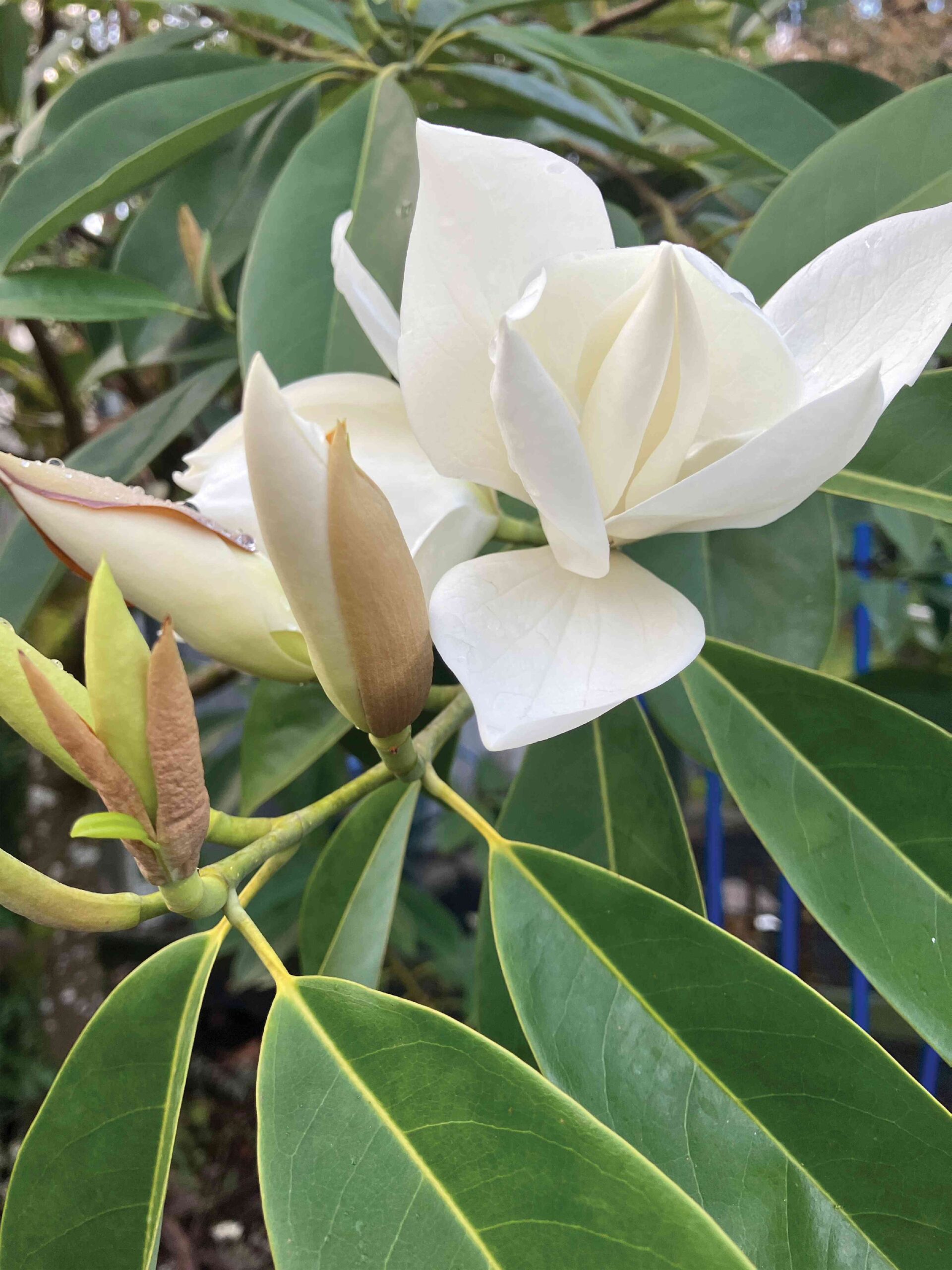
Michelia maudiae/Magnolia maudiae
Just like people, sometimes trees have their names changed. Years ago, I saw a business planted with street trees on N.E. Fremont St. in Portland that Sean Hogan, (Cistus Design Nursery), had planted with Michelia maudiae. These trees were in full bloom with fragrant white flowers.
Shortly after seeing these trees, I planted one in my garden! It is an evergreen tree with flowers that appear along the stems in early spring. Their fragrance permeates the surrounding area.
However, since the time of my planting this tree, the name has changed. Taxonomists and botanists sometimes reclassify plants based on new evidence. There are, of course, rules to follow that are set by the International Code of Botanical Nomenclature and the International Association for Plant Taxonomy. My Michelia maudiae is now known as Magnolia maudiae. Regardless of the name, it is a favorite early blooming tree in my garden.
Olive
Sometimes when we hear people talk about plants and make certain statements about them, we begin to believe them, especially when we hear other plant people espouse the same “facts.” For many years, I was told that olive trees would not grow here.
Fast forward to today, when there are even commercial olive orchards in Oregon and there is research being done to help select those trees that are cold hardy and adaptable to our climate. In my own garden, I have three Olea europaea ‘Arbequina’ olive trees that are performing quite well and seem to thrive with our recent hot dry summers.
Trees certainly offer us so much that we need to be thankful and appreciative for because we could not live without them. I think that Thomas Jefferson summed up the significance of trees with this quotation from 1793. “I never before knew the full value of trees. My house is entirely embosomed in high plane trees, with good grass below, and under them I breakfast, dine, write, read and receive my company.”